
Financial Wellbeing
Okay, We're Poly. Now Who Pays?


Three people are in an egalitarian triad. Their lives are blended. Their money is Ours.
One of them starts seeing someone new.
Whose money pays for the new relationship?
If all three incomes belong to the triad, do dates, trips and gifts for the new relationship come from that same pool? If they do, all three people are now contributing financially to a relationship only one of them is in. Or does the person who started the relationship need some money that remains Mine to support it? What happens if the new partner eventually needs financial support? What if one person dates frequently while the other two don't?
There isn't an obvious answer.
There shouldn't be.
The three people can negotiate an answer. But before they can do that meaningfully, they need to know what they're negotiating from.
What kind of financial relationship have we declared?
I've been thinking about questions like this for a very personal reason.
Lately, I've had the privilege of coming out publicly as poly. My marriage was built with some version of this future already in view. Consensual non-monogamy and polyamory were on the table by date #2. We didn't really know what that meant yet. We just knew we wanted it.
Over time, the possibilities became clearer. Was it casual sex? Outside long-term partners? Someone living with us? More than one someone?
Eventually, we met someone we both liked considerably more than casual sex.
One thing led to another. Now all three of us live together.
We're in one of those exhilarating—and occasionally challenging—periods where the relationship we've created has started asking financial questions of us.
I've also spent more than 25 years working in and around finance. A few years ago, I left corporate America and started a strategic financial services firm. Part of the reason was to build a place where I could think and write about questions exactly like this without worrying about whether the subject made an internal communications department, a legacy client base or shareholders uncomfortable. My clients choose my firm directly.
So here we are.
After Jealousy, There Are Groceries
I've read the books. If you're poly, you've probably read some of them too.
They have a lot to say about jealousy.
Fair enough. Jealousy is real. So are attachment, communication, boundaries and agreements. Many of us get pretty practiced at talking about them—sometimes with dedicated check-ins and space to say what our inner child is being particularly loud about this week.
Okay. We learned how to talk about jealousy. Now who is buying the groceries?
Poly isn't just the bedroom. Spend any time in poly community and that becomes obvious quickly. Relationships create relationships. We meet families, friends, colleagues and communities. We travel together. We negotiate calendars, dates, holidays, pets, chores, housing, work, sleep and who ate the leftovers.
Even when something begins with physical intimacy, relating to another human has a funny habit of becoming, well, a relationship.
And relationships produce practical interdependence.
Eventually, intimacy produces an economy.
Money enters whether we've given it language or not. Who paid? Who owns it? Who decides? Who benefits? Money affects where we live, what work we can leave, what risks we can take and who has choices when circumstances change. It can carry security, independence, power, generosity, fear and intimacy—sometimes several at once.
In all the reading I've done about poly relationships, I've found remarkably little that prepared me for this part.
So I started looking for better language.
Money Style
Personal finance already has plenty of identities for us. Saver. Spender. Frugal. Impulsive. They look harmless. They're not. They create shame. Over and over again. Behavior becomes identity. Judgment becomes character. Eventually, otherwise capable people start describing themselves as bad with money because their financial behavior doesn't resemble somebody else's idea of financial virtue.
I'm not particularly interested in deciding whether you're a Saver or a Spender. I'm much more interested in what identity gives you power.
At STUDIOi™, I call this Money Style: the declarations, practices, agreements and boundaries through which you choose to be with money.
It begins with an empowering declaration: this is who I intend to be with money.
Those choices can show up in how you use debt, hold cash, buy a car, invest, prepare—or don't prepare—for retirement, and share money with other people.
Consider debt.
I've worked with people across an enormous range of income and wealth. Some carry debt. Others won't touch it. Businesses make the same choice. One company may operate with substantial leverage while another keeps a debt-free balance sheet and funds expansion with cash.
We call that capital structure.
With people, we're strangely tempted to make it character.
I carry debt.
There. I said it.
That statement doesn't tell you whether my debt is affordable or whether a particular use of credit makes financial sense. Those are planning questions. It tells you something different about my Money Style: sometimes the value I place on consuming or deploying money today is greater than the cost of borrowing it.
Someone else might declare: I don't borrow for consumption.
Good. Now I know something about both of us.
Neither gets a gold star. Neither needs a scarlet letter.
I can examine whether each Money Style works in the life of the person who declared it without turning either person into a moral success or failure.
And while this conversation is about poly relationships, Money Style isn't a poly concept. Everyone has one, whether they've declared it or simply accumulated it.
Poly just makes some of the assumptions harder to ignore.
Mine, Yours, Ours
For this Field Note, I want to explore only one dimension of Money Style: how much of my financial life remains Mine, and how much becomes Ours.
Let's make the extremes deliberately extreme.
At the Mine boundary, Mine is mine.
At the Ours boundary, Mine is ours. All of it.
Those are the edges. Most arrangements will fall somewhere along the line, but it helps to know what the edges actually mean before softening them.
Neither end is an achievement. Neither is morally superior. And neither deserves shame. You can occupy Mine. You can occupy Ours. You can live anywhere between them.
More shared doesn't mean more committed.

A deeply committed triad may live close to Mine. Another may live at Ours. A V may have different Money Styles between different relationships.
Relationship style doesn't prescribe Money Style.
And then there is, of course, Yours.
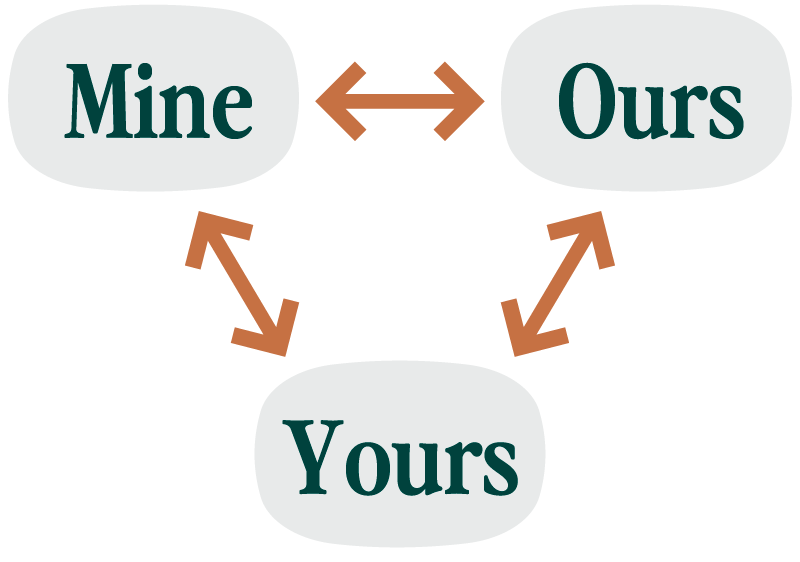
Sometimes Mine intentionally becomes Yours. People give another person ownership, control or benefit of money for all kinds of reasons. Maybe one partner is simply the money person. Maybe the arrangement reflects tradition or practical necessity. Maybe giving another person financial control is itself something someone has deliberately chosen and values.
Consent matters enormously here.
Ownership, control and benefit also aren't necessarily the same thing. An account can belong to me, be managed by you and support us. That's real too. We'll leave that concept alone for now.
The Refrigerator Test
Let's make Mine and Ours painfully ordinary.
Three people live together. They need groceries.
At Mine, everybody buys their own.
Open the refrigerator and you may find three kinds of milk. Somebody's name is on the leftovers. If I eat your yogurt, I owe you a yogurt. Maybe we occasionally buy something for one another because we're not monsters, but the financial premise remains intact:
Your food is yours. My food is mine.
Now go all the way to Ours.
All three incomes enter one shared pool. The household agrees on how much to spend on groceries. Someone goes shopping with our money and comes home with our groceries. Nobody needs to determine whose paycheck bought the eggs. Nobody needs a name on the yogurt.
Our food is ours because our money is ours.
Same refrigerator. Completely different Money Styles.
Everything between those extremes is available too. Maybe most income remains Mine while an agreed portion funds a household account. Maybe some expenses are shared and others aren't. Equal contributions are possible. Proportional contributions are possible.
At STUDIOi™, I tend to prefer something I call a Shared Money Ratio™.
But first, direction matters.
Am I fundamentally carving a little Ours out of Mine? Or am I building from Ours and carving some Mine back out?
At one end, Ours is carved out of Mine. At the other, Mine is carved out of Ours.
That distinction tells me considerably more than whether three people happen to have a joint checking account.
When the Relationship Changes Before the Money Does
Real life, of course, has the nerve not to stay on one line.
Poly can create more than one Ours. In a V, I might have an Ours with one partner and a different Money Style with another. In a throuple, there might be money that is Mine, money shared between two people, and money that belongs to all three.
An established married couple entering an egalitarian triad may already have years of shared accounts, property, investments, debts and financial history between them. The three may now be declaring something different about the relationship they're creating (Moritz, 2026; Trilling, 2025).
The relationship can change faster than the financial architecture.
Egalitarian. Nesting. Triad. Or anything else. The county recorder doesn't care.
Neither does the mortgage, the retirement account someone opened twelve years ago, or the checking account that has always belonged to two people.
That's not a failure of the relationship. It's a design constraint.
Declaring an egalitarian triad doesn't require every account to acquire a third owner by Friday. There will be gaps between the financial life that exists and the relationship being created. The creative work is understanding what exists, deciding what should remain, and designing only the containers needed to make the declared relationship increasingly workable.
Complexity can earn its place.
Money Style Empowers Consent
Now put the new relationship back into our deliberately extreme example.
The triad lives at Ours.
Mine is Ours. All three incomes enter the group. The groceries are ours. The household is ours. The money is ours.
One person starts seeing someone new.
Now the question has teeth.
Does Ours pay for Friday night's date? The hotel? A vacation? A gift? If the new metamour needs help with rent, can one member of the triad give them money that belongs to all three?
And what happened to the other two people?
If money that belonged to the three now supports a fourth relationship, the other two may have been financially subordinated to that relationship without ever consenting to it. They agreed that Mine becomes Ours. Did they also agree that Ours can support another relationship?
Maybe they did.
Maybe they would.
Maybe supporting relationships outside the triad is entirely consistent with the Money Style they've declared.
But maybe it isn’t.
Consent to a poly relationship isn't automatically consent to every financial relationship that might grow from it.
The arrival of another relationship doesn't necessarily break the triad's Money Style. It tests it.
Perhaps Ours was always meant to support the broader relational lives of all three people. Perhaps each person needs individual money from which outside relationships are supported. Perhaps the new relationship exposes that what everyone had been calling Ours was actually something more nuanced.
The answer belongs to them. What matters is that the other two aren't made financially subordinate to a new relationship they never consented to support.
Money Style empowers consent. It gives us clearer language for the roles, practices, expectations and boundaries we're inviting other people to share—and helps us recognize when those terms change.
If I intend for serious relationships eventually to become financially shared and you inted for your money always to remain yours, neither of us needs to change to prove commitment.
But we should probably know that about each other.
Start With a Direction
You don't need a complete financial architecture tonight.
Start with a direction.
Which way do you lean?

Don't worry about assigning yourself 37.1047% yet. Start by noticing which direction looks more like the financial life you intend to create.
Maybe you lean Solo. Your relationships can be intimate, committed and enduring while your financial life remains principally yours.
Maybe you lean Shared. Building a life with someone eventually means, for you, building a financial life that increasingly belongs to both—or all—of you.
Maybe you're somewhere in between.
Language Gives Us Access
Maybe the language changes as you understand yourself better.
Sometimes language doesn't create the thing. It gives us access to something that was already difficult to see.
Money can work that way too.
Some of what we carry with money is inherited—the stories, meanings and assumptions already operating. In my coaching work, I call that Money Mythos™.
What comes next can be declared: the way of being with money we intend to create and live into. I call that Money Ethos™.
Mythos helps explain how we got here. Ethos gives us somewhere to go.
Then we get to ask better questions.
Is this actually me?
Is this something I inherited?
Is this what I want—or simply the default I never thought to question?
Money can deserve that inquiry too.
Someone firmly oriented toward Mine and someone firmly oriented toward Ours may love each other deeply and still be financially incompatible. Love doesn't automatically reconcile that difference. Neither person is wrong. But the difference is real, and naming it gives both people considerably more agency in deciding what they want to create together.
If you're poly, you may discover another useful phrase along the way: money poly. Maybe meaningful financial relationships with more than one partner are part of the future you want to create, without requiring every one of those relationships to have the same Money Style.
That's enough to begin.
Live Into It
Sometimes the exercise is easy. Sometimes years of marriage, partners, property, debt, accounts and perfectly reasonable decisions made at different moments have produced a financial life nobody exactly designed. Before changing it, the useful work may simply be seeing what is already there.
I haven't found much of a financial-planning playbook for poly families. Legal and advocacy work around polyamorous and chosen families has begun to fill adjacent gaps, and that work itself emphasizes the importance of finding professionals with specific experience serving nontraditional families (Trilling, 2025).
I'm learning some of this while living it too.
My relationship changed. The financial structures around it didn't magically change with us. Some still make perfect sense. Some may need to change. Some questions don't have answers yet.
That's part of creating something.
Knowing your Money Style isn't about finding the correct place on a line. It's about knowing another piece of yourself well enough to declare it without shame—and giving the people you love something honest enough to consent to.
Know yours. Declare it. Live into it. Change it when it no longer describes you.
Authentic expression isn't something we finish discovering and put on a shelf
Go be you.
Better yet, go create you.
Cody Zindler
STUDIOi™
Coaching Money Journeys®
Something changed. Money is implicated.
If your relationships are asking financial questions that your current structures don't quite answer, a Financial Wellbeing Checkup gives us a place to look at them together.
From there, we can determine whether a Financial Portrait would help make the financial life you're actually living easier to see.
Disclosures
STUDIOi™, LLC is an Arizona-registered investment adviser. Registration does not imply a particular level of skill, training or endorsement by any regulatory authority. This Field Note is provided for educational and informational purposes only and does not constitute individualized financial planning, investment, tax or legal advice. STUDIOi provides advisory services only pursuant to a signed client agreement and within the scope of that agreement. Examples and planning concepts discussed here are illustrative and may not be appropriate for your circumstances.
Nothing in this article is a recommendation or endorsement to incur, maintain, repay or avoid debt, or to adopt any particular Money Style or Shared Money Ratio™. Debt, budgeting and other financial decisions depend on individual circumstances, including cash flow, financial condition, objectives, costs, risks and available alternatives.
STUDIOi is not a law firm or CPA firm and does not provide legal or tax advice. Readers should consult appropriately qualified financial, tax and legal professionals familiar with their individual circumstances as appropriate.
Additional information about STUDIOi™, its advisory services, fees, conflicts of interest and business practices is available in the firm's most recent Form ADV Part 2A at www.WeAreSTUDIOi.com and through the Investment Adviser Public Disclosure database at adviserinfo.sec.gov.
This article was written by Cody Zindler with artificial-intelligence tools used for research and editorial support. The author reviewed, revised and approved the final content and is responsible for the views and conclusions expressed.
STUDIOi™, Money Mythos™, Money Ethos™ and Shared Money Ratio™ are marks used by STUDIOi, LLC. Coaching Money Journeys® is a registered trademark of STUDIOi, LLC.
References
Moritz, N. (2026, August 26). In a throuple? The legal rights you may not have as a polyamorous family. FindLaw. https://www.findlaw.com/legalblogs/law-and-life/polyamory-ethical-non-monogamy-and-the-law/
Trilling, S. (2025, June). How to buy property with chosen family: A national legal starter guide to co-owning a home or land with chosen family, including poly people and families. Polyamory Legal Advocacy Coalition & LGBTQ+ Advocacy Clinic at Harvard Law School. https://harvard.turtl.co/story/how-to-buy-property-with-chosen-family/page/1

You're Leaving STUDIOi